
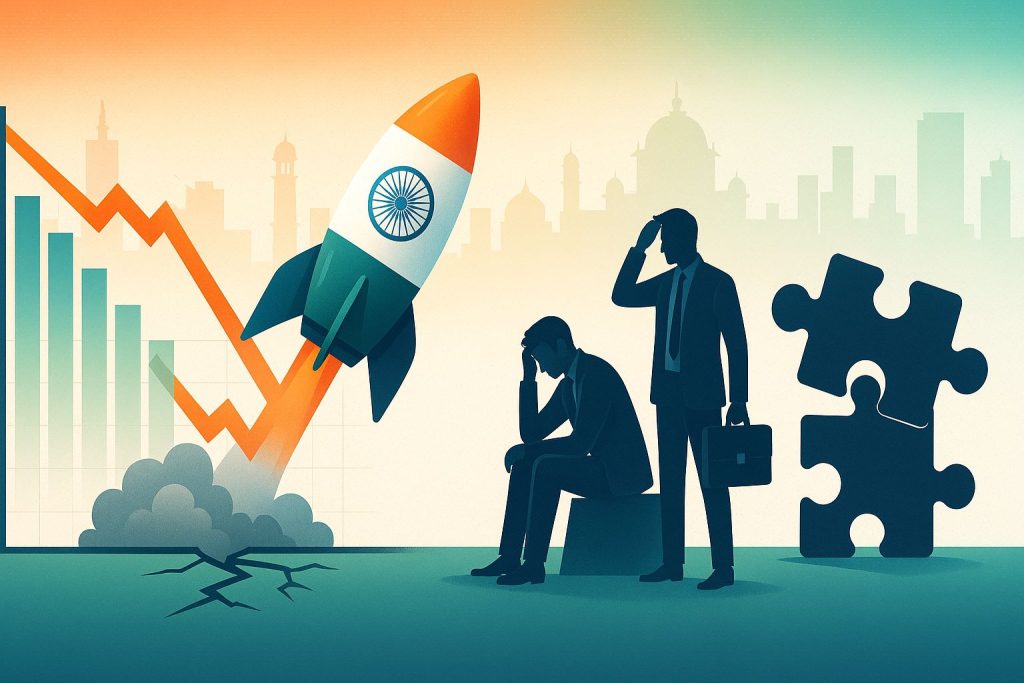
Introduction to Why Indian Statrups Fail?
Why Indian startups fail? What patterns, pitfalls, and market realities contribute to this high failure rate? And most importantly, what can future entrepreneurs learn from these failures to build lasting ventures?
India is often hailed as the world’s fastest-growing startup ecosystem, boasting over 100,000 registered startups and more than 110 unicorns as of 2025. From fintech and edtech to healthtech and e-commerce, Indian entrepreneurs have redefined innovation and global competitiveness.
Yet, behind the success stories of Byju’s, Flipkart, Zomato, and Paytm, lies a sobering reality — over 80–90% of Indian startups fail within the first five years. Despite passion, funding, and innovation, countless ventures collapse before achieving sustainability.
This blog explores these critical questions with data-backed insights, real-life case studies, and practical lessons — offering an honest roadmap for every aspiring founder in India.
1. The Harsh Reality: The Startup Failure Rate in India
According to a NASSCOM report, nearly 9 out of 10 startups in India fail within five years of launch. The most common reasons include:
- Lack of product-market fit
- Ineffective business models
- Poor financial planning
- Team mismanagement
- Legal and regulatory hurdles
- Burnout and leadership failure
Despite a booming ecosystem, only a small fraction of startups manage to achieve sustainable profitability or scalability.
In fact, many Indian unicorns are still struggling to turn profitable, signaling that the problem isn’t just starting up — it’s about staying alive.
2. Lack of Product-Market Fit: The Silent Killer
One of the top reasons startups fail globally — and especially in India — is the lack of product-market fit.
Many founders build products based on assumptions or personal enthusiasm rather than solving a real customer problem.
Example: TinyOwl
TinyOwl, a food delivery startup launched in 2014, raised millions in funding but failed to sustain its operations. Why? Because it entered a crowded space without a differentiated model or strong local execution.
The company expanded too fast, ignored operational inefficiencies, and ended up shutting down despite strong investor backing.
Lesson:
Always validate your idea with real users before scaling. Use MVPs (Minimum Viable Products), gather feedback, and iterate based on data — not emotion.
3. Ineffective Business Models and Revenue Strategies
Many Indian startups launch with exciting ideas but lack a clear revenue model or long-term sustainability plan.
Founders often chase growth over profitability, burning investor money without ensuring consistent cash flow.
Example: Doodhwala
Doodhwala, a milk delivery startup, shut down after four years despite strong initial traction. The reason? The unit economics didn’t make sense. High logistics costs and low margins made profitability impossible.
Lesson:
Growth is valuable, but profitable growth is what sustains a business. Build a business model that ensures positive unit economics, even if it means slower scaling.
4. Overdependence on Funding
Indian startups often rely heavily on venture capital for survival instead of building self-sustaining revenue streams.
While funding accelerates growth, it can also lead to complacency, overspending, and unrealistic scaling goals.
When funding dries up — as seen during the 2022–2023 funding winter — many startups collapse overnight due to poor cash flow management.
Lesson:
Funding is fuel, not oxygen. Build a startup that can breathe on its own — through customers, not just investors.
5. Poor Leadership and Team Management
A great idea needs a great team and strong leadership. Many Indian startups fail because of:
- Internal conflicts among co-founders
- Lack of delegation and accountability
- Poor hiring decisions
- Leadership ego and burnout
Example: Housing.com
Founded by a group of IITians, Housing.com gained massive attention and funding. However, internal disputes and leadership missteps led to the ouster of its CEO and eventual decline.
Lesson:
Culture and leadership matter as much as the product. Founders must build teams based on trust, communication, and shared vision — not just technical skills.
6. Ignoring Market Research and Customer Insights
Startups often skip market validation in their early stages, assuming demand where there isn’t any.
Example: PepperTap
PepperTap, a grocery delivery startup, shut down after realizing that its model was not sustainable due to logistics challenges and lack of repeat orders.
Lesson:
Conduct thorough market research before launching. Understand your audience’s pain points, buying behavior, and willingness to pay. A great idea without a market is just an illusion.
7. Overcrowded and Competitive Market
The Indian market is highly competitive, with multiple players entering the same niche simultaneously — especially in sectors like food delivery, edtech, e-commerce, and fintech.
When differentiation is weak, only those with strong brand positioning, technology, and customer loyalty survive.
Example: Craftsvilla
Once valued at over $250 million, Craftsvilla — an ethnic e-commerce platform — faded away due to competition from Amazon, Flipkart, and Myntra.
Lesson:
Identify a unique value proposition (UVP). Instead of copying trends, create a niche where you can dominate rather than compete.
8. Regulatory and Legal Challenges
India’s regulatory environment is improving, but compliance remains a challenge — especially for fintech, healthcare, and cryptocurrency startups.
Many startups face hurdles in taxation, data privacy, and licensing, which can slow down operations or lead to shutdowns.
Lesson:
Founders should invest in legal and compliance expertise early. Staying compliant builds credibility and prevents costly legal disputes later.
9. Weak Marketing and Brand Positioning
Building a great product isn’t enough — you need people to know, trust, and remember it.
Startups often fail due to:
- Poor digital marketing strategy
- Weak branding or inconsistent messaging
- Misaligned target audience
Lesson:
Marketing is not an expense — it’s an investment. Invest in SEO, social media, PR, and storytelling to create brand trust and awareness.
10. Scaling Too Fast, Too Soon
Many startups fail because they expand before achieving operational stability.
Expanding across cities or countries without strong infrastructure leads to quality decline, high costs, and poor customer satisfaction.
Example: Zilingo
Zilingo, once a promising fashion startup, grew aggressively but faced governance issues and funding challenges. Overexpansion without profitability led to its downfall.
Lesson:
Scale sustainably. Focus on perfecting one market before expanding to others.
11. Lack of Financial Discipline
Mismanagement of funds is another major reason behind startup failures. Startups often:
- Overspend on marketing and infrastructure
- Ignore financial forecasting
- Lack proper accounting and audits
Lesson:
Track every rupee. Maintain a clear budget, plan for contingencies, and ensure transparency in financial reporting.
12. Founder Burnout and Mental Health
Startup life is demanding. Long working hours, uncertainty, and constant investor pressure lead to burnout, anxiety, and poor decision-making.
According to surveys, over 60% of startup founders in India report high stress levels, and many attribute it to overwork and lack of support systems.
Lesson:
A healthy founder builds a healthy startup. Prioritize mental health, delegate tasks, and build a balanced leadership approach.
13. Inadequate Technology and Poor User Experience
Even in a tech-driven ecosystem, many startups fail due to poor technology choices and bad UX/UI design.
Customers expect speed, convenience, and reliability — especially in mobile-first India. A glitchy app or poor experience can kill customer trust instantly.
Lesson:
Invest in good technology, design, and cybersecurity from day one. Your digital product is your brand’s first impression.
14. The Cultural Factor: Risk Aversion and Copycat Syndrome
Many Indian startups are inspired by Western models — Uber for India, Airbnb for India, etc. While localization helps, blind imitation often fails.
Additionally, the Indian business culture can be risk-averse, discouraging experimentation and innovation.
Lesson:
Don’t just copy — innovate for India. Understand local consumer psychology, regional diversity, and affordability.
15. The Funding Winter and Market Correction
Between 2022–2024, the Indian startup ecosystem experienced a funding winter, with venture investments dropping by nearly 40%.
Startups that were dependent on funding faced massive layoffs, mergers, or shutdowns.
This period emphasized the importance of profitability, frugality, and customer retention over vanity metrics.
Lesson:
Economic cycles will always fluctuate. Build a resilient business that can survive tough times.
16. Case Study: The Rise and Fall of Byju’s
Byju’s was once India’s most celebrated edtech unicorn, valued at over $22 billion. But mismanagement, over-acquisitions, and lack of governance led to its decline.
The company’s downfall highlighted the dark side of unchecked expansion, lack of transparency, and investor overconfidence.
Lesson:
Governance and transparency are as important as growth. Build trust with investors, customers, and employees through ethical practices.
17. How to Avoid Startup Failure: Key Takeaways
For every failure story, there’s a lesson in resilience and learning. To build a startup that lasts:
- Focus on solving real problems
- Validate ideas before scaling
- Build a sustainable revenue model
- Maintain financial discipline
- Choose the right team and mentors
- Prioritize customer experience
- Stay compliant with legal frameworks
- Invest in marketing and brand building
- Adapt quickly to market feedback
- Take care of your mental and emotional health
18. The Future of Indian Startups
Despite the failures, India remains one of the world’s most promising startup ecosystems. Government initiatives like Startup India, Digital India, and Make in India continue to foster innovation and entrepreneurship.
The next wave of Indian startups is expected to be more sustainable, profitable, and socially conscious, learning from the mistakes of their predecessors.
Conclusion
Failure is not the opposite of success — it’s a part of it. Every Indian startup that failed contributed to the evolution of the ecosystem.
For new entrepreneurs, the key lies in learning, adapting, and building responsibly.
The Indian startup dream is alive — but only those who combine innovation with strategy, discipline, and empathy will thrive in the long run.