

India’s startup funding ecosystem in Tier 2 cities is no longer emerging—it is actively scaling. In simple terms, founders in cities like Indore, Jaipur, Kochi, Coimbatore, and Bhubaneswar now have real access to angel investors, seed funds, government grants, and early-stage VCs, often with lower competition and better capital efficiency than metro cities. This guide explains how it works, who is funding whom, and how founders can realistically raise capital outside Tier 1 hubs.
Why Startup Funding in Tier 2 Cities of India Matters Now
India’s startup story has long been metro-centric. That has changed over the last five years.
Several forces are converging:
- Remote-first work and distributed teams
- Lower startup operating costs outside metros
- Government-backed funding and incubation programs
- Growing interest from angels and micro-VCs in non-metro deals
As a result, startup funding in Tier 2 India is no longer an exception—it is becoming a parallel ecosystem.
What Are Tier 2 Cities in the Indian Startup Context?
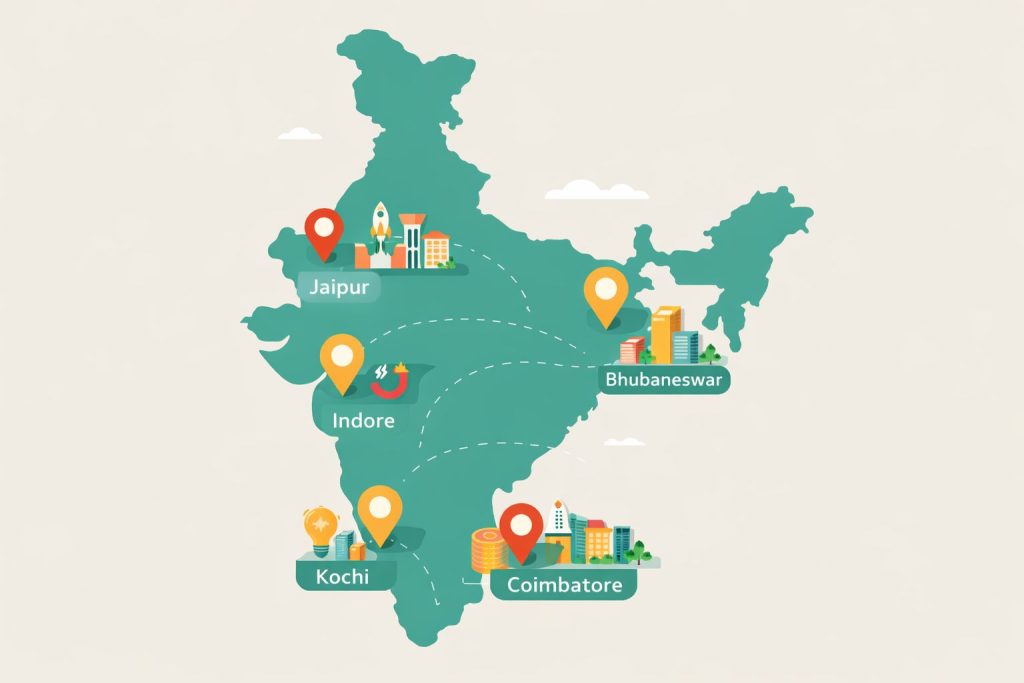
Tier 2 cities are urban centers with strong educational institutions, improving infrastructure, and growing digital adoption—but lower saturation than metros.
Common Tier 2 Startup Hubs in India
- Jaipur
- Indore
- Kochi
- Coimbatore
- Trichy
- Surat
- Vadodara
- Bhubaneswar
- Chandigarh
- Nagpur
- Vizag
These cities offer a unique mix of:
- Affordable talent
- Lower burn rates
- Easier pilot access with local governments and SMEs
How Startup Funding in Tier 2 Cities Differs From Tier 1
Understanding the differences is critical for founders adjusting expectations.
Key Differences at a Glance
| Factor | Tier 1 Cities | Tier 2 Cities |
|---|---|---|
| Investor density | Very high | Limited but growing |
| Ticket sizes | Larger | Smaller but efficient |
| Valuations | Inflated | More realistic |
| Competition | Intense | Moderate |
| Founder visibility | High | Requires proactive outreach |
Insight: Tier 2 startups often raise less capital but achieve profitability faster, which increasingly appeals to investors focused on sustainable growth.
Types of Startup Funding Available in Tier 2 India
1. Government Grants and Schemes (Most Accessible)

Government funding plays a foundational role in Tier 2 ecosystems.
Common support includes:
- Seed grants (₹10–50 lakhs)
- Prototype development funding
- Incubation support and subsidized office space
These grants are non-dilutive, making them ideal for early-stage founders.
Who should apply:
First-time founders, college spin-offs, deep-tech and impact startups.
2. Incubators and Accelerators in Tier 2 Cities
Incubators are often the entry point to funding outside metros.
What they provide:
- Small seed cheques
- Mentor access
- Investor demo days
- Credibility with future investors
Many Tier 2 incubators are backed by:
- State governments
- Universities
- PSU-led CSR initiatives
Practical tip: Start with local incubators before approaching national accelerators.
3. Angel Investors and Local Angel Networks
Angel funding in Tier 2 cities is relationship-driven.
Typical angel profile:
- Local business owners
- Second-generation entrepreneurs
- Senior professionals returning to hometowns
Ticket sizes: ₹10–75 lakhs
Stage: Idea to early traction
Key challenge: Angels may invest slower but stay involved longer.
4. Micro-VCs and Early-Stage Funds Backing Tier 2 Startups
Several funds now explicitly seek Tier 2 and Tier 3 exposure.
They look for:
- Capital-efficient models
- Clear local-market advantage
- Early revenue signals
Common focus sectors:
- SaaS
- Agri-tech
- Health-tech
- Logistics
- Vernacular consumer tech
What Investors Look for in Tier 2 Startups
Funding success depends on how well founders align with investor expectations.
Core Evaluation Criteria
1. Founder-market fit
Local insight matters more than pedigree.
2. Capital efficiency
Lower burn rates are a major advantage.
3. Early traction
Revenue, pilots, or LOIs carry more weight than pitch decks.
4. Scalability beyond the city
Investors want proof that the model can expand nationally.
Common Mistakes Tier 2 Founders Make While Raising Funding
Avoiding these errors significantly improves funding outcomes.
- Overestimating valuation based on metro benchmarks
- Waiting too long to build investor relationships
- Under-communicating traction due to modest growth numbers
- Assuming location limits scalability (it doesn’t)
Reality: Investors care about outcomes, not pin codes.
Step-by-Step: How to Raise Startup Funding from a Tier 2 City
Step 1: Validate Locally, Document Rigorously
Pilot with local customers and record measurable results.
Step 2: Join a Recognized Incubator
This builds credibility faster than cold outreach.
Step 3: Build an Investor-Ready Narrative
Explain:
- Why Tier 2 gives you an advantage
- How you scale nationally
Step 4: Leverage Warm Introductions
Use mentors, alumni networks, and incubator connections.
Step 5: Be Flexible on Terms
Early Tier 2 rounds often prioritize trust over structure.
Sector-Wise Funding Opportunities in Tier 2 India

SaaS and B2B Tools
- Favored for global scalability
- Often bootstrapped before funding
Agri-tech and Rural Commerce
- Strong government and impact funding
- Easier pilots in non-metro regions
Health-tech
- Diagnostic, telemedicine, and hospital-tech startups thrive locally
Consumer Tech (Vernacular)
- Strong traction in Tier 2 and Tier 3 user bases
Frequently Asked Questions
Is it possible to raise VC funding from a Tier 2 city in India?
Yes. Many early-stage VCs actively invest in Tier 2 startups, especially in SaaS, agri-tech, and health-tech. While networking may take longer, strong traction and capital efficiency often offset location disadvantages.
How much funding can Tier 2 startups typically raise at seed stage?
Most Tier 2 startups raise between ₹25 lakhs and ₹2 crores at seed stage, depending on traction, sector, and investor profile.
Do startups need to relocate to Bengaluru or Delhi to raise funding?
No. Relocation is optional. Many founders operate from Tier 2 cities while registering holding entities or investor relations offices in metros.
Are government grants reliable for startup funding in Tier 2 cities?
Yes, but timelines can be slow. Government grants are best used as supplementary, non-dilutive capital rather than sole funding sources.
Key Takeaways: Startup Funding in Tier 2 India
- Tier 2 cities now offer real, repeatable funding pathways
- Capital efficiency is a major competitive advantage
- Incubators and government programs are critical early enablers
- Investors increasingly value sustainable growth over hype
What Founders Should Do Next
- Map local incubators and state startup schemes
- Start tracking traction metrics early
- Build investor relationships before you need capital
- Position Tier 2 location as a strength, not a limitation
Final Thoughts
Startup funding in Tier 2 India is no longer a niche opportunity—it is a structural shift in the Indian startup ecosystem. Founders who understand the funding landscape, manage expectations, and leverage local advantages are often better positioned to build durable, fundable businesses than their metro counterparts.
The opportunity is real. Execution decides who captures it.