
Indian startups are succeeding in 2026 because they combine strong fundamentals, local problem-solving, technology adoption, and sustainable growth models.
Unlike earlier waves focused mainly on rapid expansion, today’s successful Indian startups prioritize profitability, resilience, and long-term value creation.
India’s startup ecosystem has matured. Founders are building businesses that scale responsibly, adapt quickly, and serve both domestic and global markets.
Why Are Indian Startups Thriving in 2026?
Indian startups are thriving because the ecosystem has evolved beyond experimentation into execution.
Key factors driving this success include:
- A large, digitally connected population
- Improved access to capital and infrastructure
- Founder experience from earlier startup cycles
- Policy support and ecosystem maturity
Startups today are better prepared, better governed, and more focused on real-world impact.
How Has the Indian Startup Ecosystem Evolved?
The Indian startup ecosystem in 2026 is more disciplined and outcome-driven.
Earlier phases focused on:
- User growth at any cost
- Heavy discounting
- Valuation-led narratives
Today’s ecosystem emphasizes:
- Revenue sustainability
- Unit economics
- Operational efficiency
- Strong governance
This shift has improved survival rates and long-term success.
Key Trends Driving Indian Startup Success in 2026
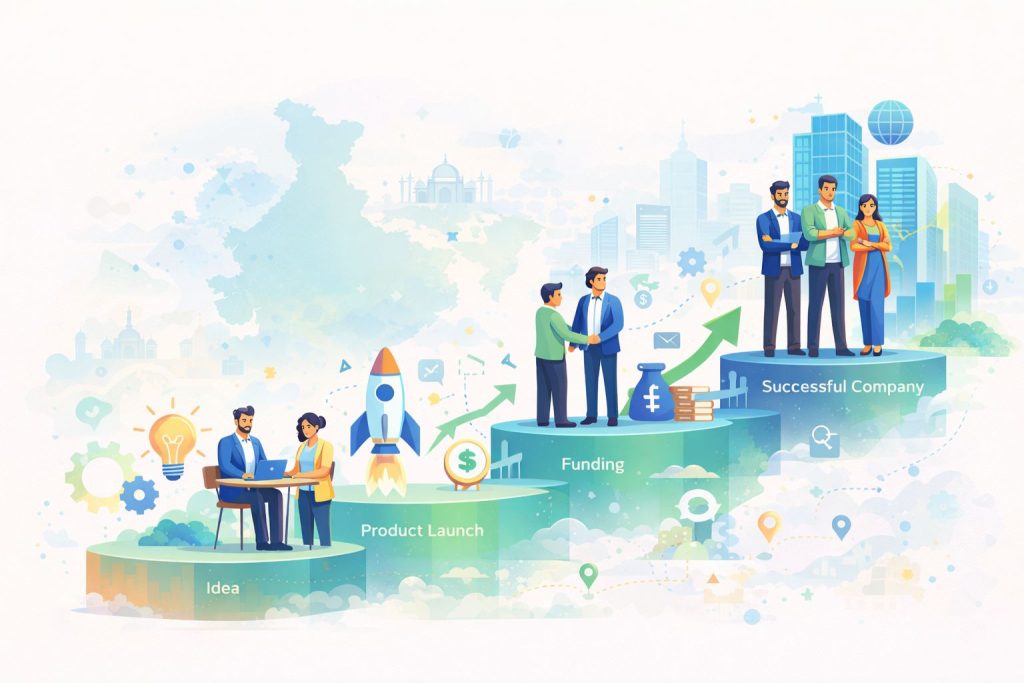
1. Focus on Profitability and Sustainable Growth
Profitability is now a priority, not an afterthought.
Successful Indian startups:
- Track unit economics closely
- Reduce burn rates
- Balance growth with margins
Investors now reward businesses that show:
- Predictable revenue
- Cost discipline
- Clear paths to profitability
This shift has created healthier companies and stronger leadership teams.
2. Solving India-First Problems at Scale
Indian startups succeed by addressing local challenges with scalable solutions.
High-impact areas include:
- Financial inclusion
- Healthcare access
- Education and skill development
- Logistics and supply chain efficiency
- Small business digitization
Startups that deeply understand local needs gain:
- Faster adoption
- Stronger trust
- Long-term customer loyalty
3. Deep Adoption of Technology and AI
Technology is no longer optional—it is core to competitiveness.
Successful startups use:
- Artificial intelligence for automation and insights
- Data analytics for decision-making
- Cloud infrastructure for scalability
Rather than building flashy features, they use technology to:
- Reduce costs
- Improve customer experience
- Increase operational efficiency
This practical approach delivers measurable business value.
4. Strong Founder Experience and Second-Time Entrepreneurs
Founder maturity is a major success factor in 2026.
Many Indian startups are now led by:
- Second-time or third-time founders
- Professionals with domain expertise
- Leaders with global exposure
Experienced founders:
- Make fewer early mistakes
- Build stronger teams
- Communicate better with investors
This experience significantly improves execution quality.
5. Better Access to Capital with Higher Accountability
Funding is more selective but more meaningful.
In 2026:
- Capital is available for strong ideas
- Due diligence is deeper
- Growth expectations are realistic
Investors prefer startups with:
- Clear business models
- Transparent metrics
- Ethical leadership
This accountability strengthens the entire ecosystem.
What Role Does Government and Policy Play?
Policy support continues to strengthen Indian startups.
Supportive measures include:
- Startup-friendly regulations
- Simplified compliance processes
- Digital public infrastructure
- Increased access to credit and grants
Public platforms and open digital systems enable startups to:
- Build faster
- Scale efficiently
- Reach underserved markets
Policy stability adds confidence for founders and investors alike.
Data Insights: What the Numbers Reveal About Indian Startups
Data shows a clear shift toward quality over quantity.
Key ecosystem insights:
- Fewer but stronger startups are being funded
- Average startup lifespans are increasing
- Revenue-focused models outperform growth-only models
Startups that survive the first three years now have:
- Higher chances of long-term success
- Better operational discipline
- Stronger customer retention
These patterns signal ecosystem maturity.
Case Study Patterns: What Successful Indian Startups Do Differently
Rather than naming individual companies, consistent patterns emerge among successful Indian startups.
Case Study Pattern 1: Customer-Centric Execution
Successful startups:
- Listen actively to customer feedback
- Iterate quickly
- Prioritize product-market fit
They grow by solving real pain points, not by chasing trends.
Case Study Pattern 2: Lean Teams with High Ownership
Winning startups:
- Maintain smaller, skilled teams
- Encourage accountability
- Reduce unnecessary hierarchy
This leads to faster decision-making and stronger execution.
Case Study Pattern 3: Clear Vision with Flexible Strategy
Top startups:
- Have a long-term vision
- Adapt strategy based on market feedback
- Avoid rigid planning
This balance enables resilience during uncertainty.
What Challenges Do Indian Startups Still Face?

Despite success, challenges remain.
Common challenges that Indian Startups Faces include:
- Talent competition
- Regulatory complexity
- Market fragmentation
- Global economic uncertainty
However, successful startups prepare for these challenges through:
- Risk management
- Diversified revenue streams
- Strong compliance practices
Preparedness separates survivors from leaders.
How Indian Startups Build Trust and Credibility
Trust is now a growth driver.
Startups build trust by:
- Transparent communication
- Ethical business practices
- Consistent product quality
- Reliable customer support
Trust improves:
- Customer retention
- Investor confidence
- Brand reputation
This aligns closely with long-term success.
What Can New Founders Learn from Successful Indian Startups?
New founders can learn to:
- Validate ideas early
- Focus on fundamentals
- Avoid over-scaling too fast
- Build strong teams
- Measure what truly matters
Success in 2026 comes from discipline, not shortcuts.
The Role of Culture in Startup Success
Company culture directly impacts execution quality.
Successful Indian startups promote:
- Ownership and accountability
- Learning and adaptability
- Inclusivity and collaboration
A strong culture improves:
- Employee retention
- Innovation
- Decision-making
Culture is a strategic advantage, not a soft factor.
Are Indian Startups Ready for Global Markets?
Many Indian startups are now globally competitive.
They succeed internationally by:
- Building cost-efficient models
- Adapting products to local markets
- Leveraging India’s talent advantage
Global readiness is increasingly built into business strategy from day one.
What Makes Indian Startups Different from Other Markets?
Indian startups stand out because they:
- Operate at massive scale
- Innovate under constraints
- Balance affordability with quality
This ability to do more with less creates globally relevant solutions.
FAQs About Indian Startups in 2026
What makes Indian startups successful today?
A focus on profitability, local problem-solving, technology adoption, and strong leadership.
Are Indian startups still growing rapidly?
Yes, but growth is now more sustainable and disciplined.
Which sectors perform best for Indian startups?
Healthcare, fintech, education, logistics, and enterprise technology.
Is funding still available for Indian startups?
Yes, for startups with strong fundamentals and clear business models.
Can new founders still succeed in India?
Absolutely, with the right preparation, execution, and mindset.
Final Thoughts: The Real Reason Indian Startups Succeed in 2026
Indian startups succeed in 2026 because they have learned from the past and built for the future.
They combine:
- Execution discipline
- Deep market understanding
- Responsible growth
- Technological efficiency
Success is no longer about hype or valuation—it’s about building businesses that last.
Indian startups are not just surviving.
They are setting a new standard for sustainable innovation.